Today was our second full day in Tashkent. We felt much better and tackled the metro and saw some great sights. Lloyd figures we walked well over 5 miles, and possibly even close to 10.
Last night we managed to stay up until 9:00 then clonked out but woke up about 1:30, both wide awake. I was able to go back to sleep quickly, but not before noting that Tashkent is an almost freakishly quiet city. I think we are in a pretty quiet part of town, but even so the quiet of the streets is notable. I live on a golf course where I can clearly hear owls (and not much else) and this seems quiet to me. During the day the city is not much more noisy. Even when drivers honk their horns they use a sort of polite stutter of the horn. Police, whether directing tourists away from a forbidden pathway (yeah, that was me) or trying to stop a speeding Lada as they clock the speed while standing on the sidewalk holding a small radar gun, blow ineffectually on whistles like a London bobby trying to stop Jack the Ripper.
I wanted to take the Metro after reading so many good things about it. I read that Uzbeks are justifiably proud of it. That it is safe and efficient. That the number of police guarding the stations and the mandatory baggage examination, while slightly disconcerting, ensured the safety of the metro system. I read about the wonderful art and architecture, and that each stop has its own theme and art. I read this in several places. This morning, at breakfast, Lloyd somehow managed to find the one alarming article about the metro from 2006. The article warned of overzealous police officers who will take your passport and then ask for money to give it back. There were suggestions to lie about having your passport, to hand over a copy only, to lie about having US dollars and, above all, to never, ever let the police take you to a room. Then there were personal anecdotes from people claiming that the police had hassled them and one person claimed to have worn a sign, in Russian, stating that this was the 10th time the police had stopped him and, if they wanted to stop him again, they should just take him to the embassy.
So this was the one web site about the metro that Lloyd saw, and he was, perhaps understandably, freaked out about taking the subway. I did my best to change his mind by insulting his bravery, if not his manhood (I’m such a good wife) so off to the metro we went. As we approached our metro stop the atmosphere of the city and the people we were encountering seemed to change. Workers were still using straw brooms to sweep dust and debris into little piles but I felt apprehension in the air. I couldn’t tell if I was projecting, worrying about dragging Lloyd into yet another scary situation against his better judgment. Then I started noticing the police officers. A LOT of police officers. As we approached the metro they stood at every corner and there were several placed at intervals in the blocks between the several intersections surrounding the metro stop. We had to cross the street and the police officer on the corner indicated that we should go ahead. We dutifully looked at the pedestrian stop light and proceeded on green but, as we reached the middle of the street and looked for oncoming traffic we noticed that even more police officers had stopped and held traffic about half a block away. As we approached the intersection we saw, walking through the intersection with an automatic weapon casually strung across his chest, a military officer in combat fatigues. It was starting to look like the a parade or a dignitary’s procession. And it was freaky. After we crossed the intersection we had about three quarters of a block to walk to reach our metro station and we passed three more police officers, just standing at parade rest. The third one asked of we were going to the metro and pointed it out to us. We passed two more police officers as we descended the stairs. The ticket booth was easy, the attendant friendly and helpful, and then we entered the station. There, two more police officers awaited us. The (very) young man who engaged us first asked if we were tourists. He then asked Lloyd to place his backpack on a small examination table and to open it. He looked at the tops of the contents then asked from my passport, examining the information page and the Uzbekistan visa. But when Lloyd unzipped his pocket to get his passport the police officer waved him away and he never asked to look at my backpack. He was polite, respectful, and accommodating of our lack of local – oh, heck, any of several locally useful – language. So: were we freaked out? Yes. Did the actual experience with officials on the metro turn out any different than we expected? Absolutely not.
We entered the metro at Kosmonavtiar station, which seemed to be dedicated to the conquest of space (by cosmonauts? Oh, why didn’t I try harder to learn the language?). The station was painted in space-blues. Above the entrance steps was a flattened representation of the earth and orbiting planets. Beautiful, pressed glass tiles adorned all of the columns. Pictures of astronauts (Kosmonavtiar?) lined the walls. The stations of this simple, yet simply effective metro system were clearly outlined. Overall, we had less trouble negotiating the Tashkent metro than the skytrain between terminals at JFK.
Then, the train approached. The delightful, 70’s era train, painted sky blue. It looked friendly. It looked nostalgic. It did NOT look streamlined. Inside the clean, uncrowded cars we found seats and tried to absorb all of the other stations we passed through. There are no pictures allowed in the metro, but I think you could find pictures on the internet and it might be worth the effort to do so.
We left the metro at Chorsu stop and passed a cordon of police officers who by now seemed like helpful sentries. And entered the scene that brings me back to Asia again and again.
I once listened to an economics podcast where the hosts gave candy to a group of 10-year olds. The candy they chose was the least likely to appeal to kids. For example, it included raisins and Fig Newtons. The hosts asked the students to rate how happy they were with their choices, summing the scores for a numerical representation of the class’s overall level of happiness. Then an interesting thing happened. The kids started to trade. After all the trading, the happiness score was computed again and the overall level of happiness increased. By the way, the Fig Newtons went to the foreign student who had never had them and didn’t know any better. The point is, given the slightest amount of freedom of movement and a place to do it, humans will create markets. They will buy and sell and increase overall levels of happiness. In many places of the world that I love to visit, these markets are fantastic places filled with earnest buyers and sellers. Entering these markets allows me to gain, in a very short period of time, appreciation for the life of the good folks whose countries and cities I visit.

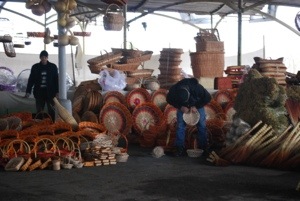
Lloyd and I bought a beautiful round of bread from among a vast array of beautiful bread. We wandered through a small area where folks sold used household goods ranging from waffle irons to faucets to hand tools. We found the vegetable section, the basket section, the straw broom section the candy section (delicious smells) the spice section (even more delicious smells) and the meat section (surprisingly unsmelly despite no apparent means of refrigeration). We thought we bought an unusually large kiwi but it turned out to be an unusually green radish. We were ‘salaamed’ and ‘good morninged.’ We saw no other Westerners. We avoided puddles seeping from buildings. We salivated over bowls of noodles and beautiful fresh fruit. We loved it.
After the bazaar we walked to Khost Imom complex. We took pictures but didn’t spend much time as we’re going there tomorrow on official tour. Then we took to the streets of the traditional old city. The sidewalks were broken or didn’t exist. Water wept onto the street from small drainage canals. The walkways were furiously swept of debris, despite their composition of mud and busted concrete. Here and there the bones of the mud-and-straw walls peeked through their whitewashed plaster covering. Children in bright clothing and seemingly anachronistic backpacks walked home from school. Mothers watched toddlers’ antics. Older folks sat in chairs in gated courtyards, the gates slightly ajar so they could observe the machinations of the neighborhood. Occasionally, a freshly renovated garage door or set of windows belied a wealthier resident. We got lost, but, in doing so, found our way to observe this society. We clearly didn’t belong but, perhaps not as oddly as one might think, we were glared at a lot less than we were yesterday. People looked at us with curiosity, but I didn’t sense animus.

After winding our way through the neighborhoods, we found our way to Chagatai Cemetery. According to the guidebook, this is a neighborhood cemetery with a “crowded mix of Muslim and Soviet Style remembrance”. By this time the sun had come out in full force, strong and warm, and we were sweating through our jackets. We took advantage of the many, many corners to sit an contemplate to, well, sit and contemplate. We heard crows (as one might, in a cemetery) and saw only maintenance workers and a couple of people paying respects. The main part of the cemetery hosts regular citizens while one smaller section features memorials to “servants of the people”, each commemorated with forceful busts. Freakishly, Lloyd claimed he saw a black, wild dog. We haven’t seen but three dogs in this country. I didn’t see this one. It seems like an omen to me, but I’m not going to let it temper my vacation.
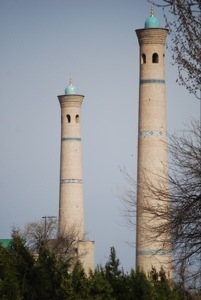
We left the cemetery. I thought I might want some tea. We walked past a shop with a fantastic, indoors tropical courtyard. A few men sat at tables drinking tea from green and white ceramic tea pots. But, as with the circus the day before, we couldn’t figure out how to give anyone our money and order tea. Just outside the door, a small group of men gathered around a man slightly older than we are as he flew a kite. The white kite seemed to float serenely against the clear blue sky. The man eagerly encouraged me to hold the string (while he kept protective hold on the stick around which wound a good amount of brilliant white string). The string, exhibiting a deceptively gentle bow toward earth, strummed and vibrated in my hand and cut against my skin. I could tell, with the limited give the kite’s master gave me, that I in no way would be able to control that kite as it sought to ride the upper air currents and escape into the atmosphere. The group of men, all in black, all sporting dark looks and quiet demeanor, broke into smiles as I gawped and then laughed at the power of that paper kite and cotton string.
It was a day for kites. The breeze was steady, the sun warm and the sky crystal clear an blue. We saw them sold along the street. We saw them floating on the horizon. We saw children and adults flying them. We saw fathers teaching their sons how to fly them. The number of kites tangled in the power lines were a testament to their popularity, and to the vagaries of the wind and the challenge of controlling kites in the city streets.
The last highlight of our outing was a stop for lunch at a clean, simple restaurant. First, we passed the open doorways of the kitchen area with a concrete, mounded bread oven and open flames. Then we passed the windows of the dining room and noted the number of diners and the comfortable look of the dining area. Finally we came to the doorway through which was passing a satisfied diner who said “Welcome” and made such a gracious, welcoming gesture into the interior we felt like long-expected guests. The waiter asked if we spoke Russian but seemed to be able to communicate perfectly well in English. We were served green tea and ordered food based on pictures in the menu. We each got a noodles dish (after seeing those wonderful mounds of noodles earlier in the bazaar how could we not?) and got two distinctly different and decidedly delicious dishes. We walked away satisfied and happy.

The walk back to the hotel allowed us to retrace some of yesterday’s route. We found the sidewalks and walkways to be much more lively and friendly than yesterday. Instead of glares, many people tried to talk to us. People asked us if we were tourists (really, how could they tell?) and tried their English on us. If we found someone staring curiously at us, one of us would say “sala’am alaykum” and, more often than not, the person would break into a smile and greet us in return. When we passed yet another open hole in the middle of the sidewalk with no protection, warning or barrier, Lloyd said “Here you can see what good all the law suits in America can do.”

We spent the rest of the day trying to ease our weary bones. We both jog on the treadmill, yet today’s walk seemed quite strenuous. We thoroughly enjoyed our outing and loved all of our discoveries in Old Tashkent.
 ericazen's Blog