Although we arrived in Khiva last night, today was our first full day in this fantastical place. The day started when the sun rose outside our window and revealed, just across a roadway, the walls and western gate of the Ichon Qala (Inner City).
We then had breakfast at our guest house. Again, breakfast was pretty straightforward: assortment of breads and rolls, cheese, a salami-like meat, peanuts fried in sugar, something like labneh (I don’t know what this is in Uzbek – I think we were told it was milk, but, while it was delicious, the sour curds would surprise someone thinking they were drinking plain milk) jam, honey, butter, instant coffee in a teapot, two eggs, sunny-side up, fried in oil. It was all pretty delicious.
Then we met our tour guide. She was very energetic and incredibly knowledgable. Along the way, I asked her how she became a tour guide. She studied tourism at school and then was certified after further study in Moscow. She said it was a good job for her because she didn’t have opportunity to travel but, through this job, had the opportunity to learn about other places through the people she met. For the second time on this trip, we amazed a Muslim woman with our descriptions of life in Saudi Arabia. They were amazed that women had to cover. They were amazed that I had to cover my hair and wear an abaya when I was there. I describe my experiences with modesty requirements in the blandest of terms, but they are still amazed.
Now, Khiva.

There are several legends about how Khiva got its name. Our tour guide favored the one that said it was a very rough translation of “sweet water”, based on the contents of the well at the North gate that refreshed thirst caravans along the Silk Road. One legend says that Khiva was founded by Shem, Noah’s son, but our tour guide pointed out that many towns in the area claim that same birthright. Archeologists place the founding of Khiva in the 5th or 6th century. One of my favorite travelers, Ibn Battuta visited Khiva in the 14th century.
Khiva was known for trading in slaves. Slaves from an amazingly wide region – from China to Russia – were traded here. In 1819 Russian Captain Nikoli Muraviev traveled to Khiva, in disguise, to open up trade relations. As if his mission of mercantile friendship were not dangerous enough, he was to reconnoiter the strengths of the Khivan Kingdom and to assess the welfare of Russian slaves.
It’s difficult for me to comprehend the importance of Khiva – or, for that matter, rival khanates of Bukhara and Kokand – especially when confronted with a town that is so small, quiet and neighborly. We confined our explorations over the two days we spent here to the inner walled city. Our impressions of the city started with the tour, but continued to develop as we observed and even interacted with those who live a life within a mud-walled city, in mud-walled houses.
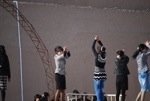
preparing for Navrus celebration dance
But first we had our tour. Our guide’s accent frequently seemed Russian but, every now and then, she would say “Quite right” to one of our observations with delivery and diction that would have been at home in the British Raj. She gave infinitely more credit to our western education and our personal learnedness that was deserved. She would refer to something I might have read about in preparation for this trip and, when I showed vague familiarity, would say “you know it quite well, I think”. Or she would refer to something we SHOULD know, such as when she pointed out the statue honoring the discoverer of the mathematical algorithm, al-Khorezmi, and she would assure us “you know it very well”. Often she would quiz us on topics she had explained earlier, keeping us on our toes and alert. She ‘tricked’ us into thinking we were seeing a blue-tiled courtyard for a second time then laughed at our confusion. The tour was challenging and engaging, delightful and insightful all in one.

Tile with Zoroastrian roots: good thoughts, good words, good deeds make a good person
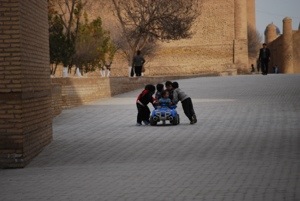
Although I cherish seeing the ancient buildings of Khiva (or, after slightly less ancient restorations, representations of the ancient buildings of Khiva), I also cherish the opportunity to walk through the neighborhoods that still reside in the city. School children played unsupervised in the streets, as there were hardly any cars. Children coming home from school tested their English on us and one little girl showed us her English language book. Women gathered together in groups while men looked under the hoods of cars. Cooking smells came through open windows. Groups of children were everywhere, playing games, running from here to there, sharing a bicycle. Cere areas of beige dirt that, to my eyes looked like waste ground were, in fact, garden plots. In which the very early spring plantings were nurtured with bottles of water. In the evening we sat on the front steps of our hotel just outside the west gate of the Dishon Qala, splitting a beer. A few steps from the shiny, scrubbed tiles of our hotel – and seemingly attached to it – was a mud-walled building. Several front doors pierced the front and there was a shared, covered front court yard that included an outdoor mud oven. While we sat there enjoying the night, a woman and a toddler emerged from one of the front doors. The two walked around the corner then returned presently with a bag of shopping. Then a man emerged with a toy tricycle. The trike was top heavy and the toddler soon tipped it over, but the man and the woman righted him and soon the man and the toddler made their way slowly through the quiet streets while the woman returned home to make dinner.
Soon, another woman with a small girl and a babe in arms approached the same front door. The little girl knocked on the door then stood, politely upright with her hands folded, waiting for the invitation to enter. The visit was short and the trio soon left. About this time, a young boy of about 10 approached us. We were working on our iPads and he watched in fascination. Lloyd showed him a drawing program then I showed him a program to learn the piano. Soon he was playing “When the Saints Go Marching In” recognizable by any Mardis Gras band.

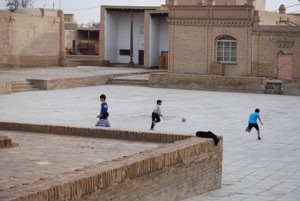
So my impression of Khiva is not just that of an ancient city but that of a bygone time when people visited each other in the evenings and when children played outside in the streets. we watched a group of boys play soccer / football in the courtyard where executions were carried out, juxtaposing two eras.
I have append one more impression of Khiva. On our second day the inner city was visited by what must have been a platoon of police officers – many of them young and slightly uncomfortable in their uniforms making me think of recruits. At first it was disconcerting until one noticed their hands full of souvenirs. Just outside the West Gate was a corner business with an outside courtyard that I noted was full of cops of obvious rank. I said – and here I must apologize to all of those who proudly protect and serve – “look, it must be the doughnut shop!” When I saw the business sign, I realized, to reference The Band, we were talking about a completely different kind of doughnut and a different kind of tea.

 ericazen's Blog