Night Train to Bukhara

Night Train to Bukhara

It’s nearly 3:00 am and by the window of my “luxe compartment for two” passes a dozen meters of lighted desert. Beyond that stretches a night so dark it might as well be oblivion. The small bit of the world known to me is populated by scrubby brush that never reaches past knee-high. Occasionally, and mysteriously, the scene is broken by a pole lamp whose oasis of light, appearing solid- seems to approach the train rather than the other way around. At one point we seemed to sway though a sand storm, creating an uneven pizzicato against the window.

Our train seems to hail from the end of Soviet times and, I’m afraid hasn’t been cleaned much since. The luxury compartment boasts a television, a kidney bean shaped desk cloaked in a golden cloth, bunk beds and a bathroom. The bathroom is wonderful. There is a decent sized shower with a modern-looking curved glass door set in a white plastic frame, a regular, western toilet and a small pedestal sink. And about a decade of grime in the corners (without going in to too much detail, the state of the toilet seat nearly met my standard of the very worst toilet seat ever, found in a bar in The French Quarter of New Orleans). The compartment features shiny wood, jewel-encrusted ventilation holes in the door, decorative wall plates, a print showing a desert oasis, and a fanciful mirror with an etched skyline of Khorezm-inspired minarets and domes. There is a porter who brought us clean sheets and green tea. Being Lloyd and Erica, we found beers, although Lloyd had to wake up the bartender to get them. On his trip through the train to the dining car, Lloyd discovered that all the cars are sleeping cars, unlike the trains in China who, despite overnight travel, had both sleeping and regular passenger cars. Not all of the cars, however, were luxe.

When we arrived at the large train station in Urgench the folks working there, from security to railway employees, didn’t seem to be familiar with the type of ticket we had. Twice we had to show them that the ticket was for two people. The engineer who showed us to our compartment seemed to have trouble determining which was listed on the ticket. When he showed us the compartment, he had to remove a leather jacket from the closet in the compartment. I suspect that these luxe compartments are used so infrequently the train-based personnel set up camp in them. As with the domestic flight we took from Tashkent to Urgench, the train left exactly on time. My impression thus far is of a nearly obsessive punctuality in Uzbeks: all of our guides and drivers have shown up quite early (true, we were ready for them, as Lloyd is equally obsessed) and now two forms of mass transportation have been reliably on time. After American-based airlines and Amtrak it’s an incredibly welcome change.

I love traveling overnight by train. Simultaneously sleeping and reaching my destination meets my need for nomadism. The rhythmic forward progress is soothing. Unlike any other form of transportation, I have never felt the least bit of motion sickness on a train. Unlike most other forms of transport, I can read and write while traveling on a train. Once my body has adopted the rhythm of the train I can perform tasks that normally require stillness such as pouring tea or, in China, use the squat (in the floor) toilets.

Fantastic! We’re stopped on the tracks for some train-traffic reason and a thunder storm has just passed over us. There are brilliant flashes of lightening that illuminated a beautiful and untouched – if harsh – desert scape. The rain storm, ever more mobile, washed over the train and continued along its way. Thunder marches toward the horizon unfettered by landscape.

Khiva, Uzbekistan

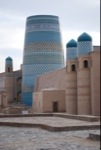
Although we arrived in Khiva last night, today was our first full day in this fantastical place. The day started when the sun rose outside our window and revealed, just across a roadway, the walls and western gate of the Ichon Qala (Inner City).

We then had breakfast at our guest house. Again, breakfast was pretty straightforward: assortment of breads and rolls, cheese, a salami-like meat, peanuts fried in sugar, something like labneh (I don’t know what this is in Uzbek – I think we were told it was milk, but, while it was delicious, the sour curds would surprise someone thinking they were drinking plain milk) jam, honey, butter, instant coffee in a teapot, two eggs, sunny-side up, fried in oil. It was all pretty delicious.

Then we met our tour guide. She was very energetic and incredibly knowledgable. Along the way, I asked her how she became a tour guide. She studied tourism at school and then was certified after further study in Moscow. She said it was a good job for her because she didn’t have opportunity to travel but, through this job, had the opportunity to learn about other places through the people she met. For the second time on this trip, we amazed a Muslim woman with our descriptions of life in Saudi Arabia. They were amazed that women had to cover. They were amazed that I had to cover my hair and wear an abaya when I was there. I describe my experiences with modesty requirements in the blandest of terms, but they are still amazed.

Now, Khiva.
20130317-055558.jpg

There are several legends about how Khiva got its name. Our tour guide favored the one that said it was a very rough translation of “sweet water”, based on the contents of the well at the North gate that refreshed thirst caravans along the Silk Road. One legend says that Khiva was founded by Shem, Noah’s son, but our tour guide pointed out that many towns in the area claim that same birthright. Archeologists place the founding of Khiva in the 5th or 6th century. One of my favorite travelers, Ibn Battuta visited Khiva in the 14th century.

Khiva was known for trading in slaves. Slaves from an amazingly wide region – from China to Russia – were traded here. In 1819 Russian Captain Nikoli Muraviev traveled to Khiva, in disguise, to open up trade relations. As if his mission of mercantile friendship were not dangerous enough, he was to reconnoiter the strengths of the Khivan Kingdom and to assess the welfare of Russian slaves.

It’s difficult for me to comprehend the importance of Khiva – or, for that matter, rival khanates of Bukhara and Kokand – especially when confronted with a town that is so small, quiet and neighborly. We confined our explorations over the two days we spent here to the inner walled city. Our impressions of the city started with the tour, but continued to develop as we observed and even interacted with those who live a life within a mud-walled city, in mud-walled houses.
20130317-060515.jpg
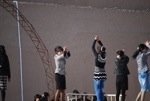
preparing for Navrus celebration dance

But first we had our tour. Our guide’s accent frequently seemed Russian but, every now and then, she would say “Quite right” to one of our observations with delivery and diction that would have been at home in the British Raj. She gave infinitely more credit to our western education and our personal learnedness that was deserved. She would refer to something I might have read about in preparation for this trip and, when I showed vague familiarity, would say “you know it quite well, I think”. Or she would refer to something we SHOULD know, such as when she pointed out the statue honoring the discoverer of the mathematical algorithm, al-Khorezmi, and she would assure us “you know it very well”. Often she would quiz us on topics she had explained earlier, keeping us on our toes and alert. She ‘tricked’ us into thinking we were seeing a blue-tiled courtyard for a second time then laughed at our confusion. The tour was challenging and engaging, delightful and insightful all in one.
20130317-061936.jpg

Tile with Zoroastrian roots: good thoughts, good words, good deeds make a good person

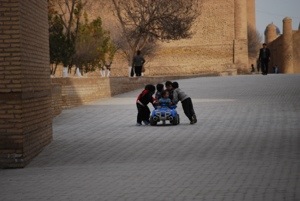
Although I cherish seeing the ancient buildings of Khiva (or, after slightly less ancient restorations, representations of the ancient buildings of Khiva), I also cherish the opportunity to walk through the neighborhoods that still reside in the city. School children played unsupervised in the streets, as there were hardly any cars. Children coming home from school tested their English on us and one little girl showed us her English language book. Women gathered together in groups while men looked under the hoods of cars. Cooking smells came through open windows. Groups of children were everywhere, playing games, running from here to there, sharing a bicycle. Cere areas of beige dirt that, to my eyes looked like waste ground were, in fact, garden plots. In which the very early spring plantings were nurtured with bottles of water. In the evening we sat on the front steps of our hotel just outside the west gate of the Dishon Qala, splitting a beer. A few steps from the shiny, scrubbed tiles of our hotel – and seemingly attached to it – was a mud-walled building. Several front doors pierced the front and there was a shared, covered front court yard that included an outdoor mud oven. While we sat there enjoying the night, a woman and a toddler emerged from one of the front doors. The two walked around the corner then returned presently with a bag of shopping. Then a man emerged with a toy tricycle. The trike was top heavy and the toddler soon tipped it over, but the man and the woman righted him and soon the man and the toddler made their way slowly through the quiet streets while the woman returned home to make dinner.

Soon, another woman with a small girl and a babe in arms approached the same front door. The little girl knocked on the door then stood, politely upright with her hands folded, waiting for the invitation to enter. The visit was short and the trio soon left. About this time, a young boy of about 10 approached us. We were working on our iPads and he watched in fascination. Lloyd showed him a drawing program then I showed him a program to learn the piano. Soon he was playing “When the Saints Go Marching In” recognizable by any Mardis Gras band.
20130317-060120.jpg
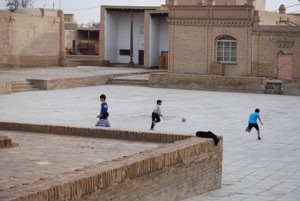
So my impression of Khiva is not just that of an ancient city but that of a bygone time when people visited each other in the evenings and when children played outside in the streets. we watched a group of boys play soccer / football in the courtyard where executions were carried out, juxtaposing two eras.
20130317-061133.jpg
20130317-061304.jpg

I have append one more impression of Khiva. On our second day the inner city was visited by what must have been a platoon of police officers – many of them young and slightly uncomfortable in their uniforms making me think of recruits. At first it was disconcerting until one noticed their hands full of souvenirs. Just outside the West Gate was a corner business with an outside courtyard that I noted was full of cops of obvious rank. I said – and here I must apologize to all of those who proudly protect and serve – “look, it must be the doughnut shop!” When I saw the business sign, I realized, to reference The Band, we were talking about a completely different kind of doughnut and a different kind of tea.

20130317-061716.jpg

Addendum to our Tashkent metro experience

Addendum to our metro trip.

During our formal tour of Tashkent we described our experience walking to the metro. We described how the streets were closed to traffic and that there were police standing at a vigilant parade rest every 20 yards or so. Our tour guide asked what time this was and, when we told her, said that every week day at that time and every weekday evening the streets are closed so the president of Uzbekistan, Islam Karamov, can drive to and from his working office. Then Alisher, our driver, added an advisory against using our cameras at that time.

World Politics

World politics

Or Tashkent driver, Alisher, drove us from the airport upon our arrival, stopping for much appreciated bottles of water on the way. He drove us on our formal tour today. And he drove us to the airport tonight. He was very helpful and his English was excellent. He explained to us tonight the meaning of the stork as a symbol to Uzbeks (wealth and luck), comparing it to our meaning for a stork (delivering babies). He explained this to us on the drive to the airport, further explaining that he couldn’t tell us earlier, on the tour, when I had asked the tour guide the question, because at that time he wasn’t a tour guide, “only a driver”.

On our drive to the airport tonight he talked about how he had a satellite for watching television in his home. He said he watched our president speak to congress and promise jobs for all, quality education for all and health care for all. Then he said he turned away from the television for a minute and when he returned, someone else was talking and saying that the president shouldn’t promise anything he couldn’t deliver. He was a little confused over the purpose of this. Lloyd explained that there are two main parties in our democratic system and that the opposing party to the president’s party gave another view point. Alisher got it right away, understanding that this was a representative of the other party giving the party’s opinion.

Let me say that I can’t stand watching the state of the union address or the rebuttal. This has been the case for most of my adult life, regardless of which party is in power. I won’t expound my reasons. I will make this open plea to all politicians. Please be sincere. There are earnest people, in corners of the world and whose lives you can probably not even imagine, earnestly hanging on your every word and trying to gain understanding. Please, make our system look good. Please set a good example.

Day Two in Tashkent

Today was our second full day in Tashkent. We felt much better and tackled the metro and saw some great sights. Lloyd figures we walked well over 5 miles, and possibly even close to 10.

Last night we managed to stay up until 9:00 then clonked out but woke up about 1:30, both wide awake. I was able to go back to sleep quickly, but not before noting that Tashkent is an almost freakishly quiet city. I think we are in a pretty quiet part of town, but even so the quiet of the streets is notable. I live on a golf course where I can clearly hear owls (and not much else) and this seems quiet to me. During the day the city is not much more noisy. Even when drivers honk their horns they use a sort of polite stutter of the horn. Police, whether directing tourists away from a forbidden pathway (yeah, that was me) or trying to stop a speeding Lada as they clock the speed while standing on the sidewalk holding a small radar gun, blow ineffectually on whistles like a London bobby trying to stop Jack the Ripper.

I wanted to take the Metro after reading so many good things about it. I read that Uzbeks are justifiably proud of it. That it is safe and efficient. That the number of police guarding the stations and the mandatory baggage examination, while slightly disconcerting, ensured the safety of the metro system. I read about the wonderful art and architecture, and that each stop has its own theme and art. I read this in several places. This morning, at breakfast, Lloyd somehow managed to find the one alarming article about the metro from 2006. The article warned of overzealous police officers who will take your passport and then ask for money to give it back. There were suggestions to lie about having your passport, to hand over a copy only, to lie about having US dollars and, above all, to never, ever let the police take you to a room. Then there were personal anecdotes from people claiming that the police had hassled them and one person claimed to have worn a sign, in Russian, stating that this was the 10th time the police had stopped him and, if they wanted to stop him again, they should just take him to the embassy.

So this was the one web site about the metro that Lloyd saw, and he was, perhaps understandably, freaked out about taking the subway. I did my best to change his mind by insulting his bravery, if not his manhood (I’m such a good wife) so off to the metro we went. As we approached our metro stop the atmosphere of the city and the people we were encountering seemed to change. Workers were still using straw brooms to sweep dust and debris into little piles but I felt apprehension in the air. I couldn’t tell if I was projecting, worrying about dragging Lloyd into yet another scary situation against his better judgment. Then I started noticing the police officers. A LOT of police officers. As we approached the metro they stood at every corner and there were several placed at intervals in the blocks between the several intersections surrounding the metro stop. We had to cross the street and the police officer on the corner indicated that we should go ahead. We dutifully looked at the pedestrian stop light and proceeded on green but, as we reached the middle of the street and looked for oncoming traffic we noticed that even more police officers had stopped and held traffic about half a block away. As we approached the intersection we saw, walking through the intersection with an automatic weapon casually strung across his chest, a military officer in combat fatigues. It was starting to look like the a parade or a dignitary’s procession. And it was freaky. After we crossed the intersection we had about three quarters of a block to walk to reach our metro station and we passed three more police officers, just standing at parade rest. The third one asked of we were going to the metro and pointed it out to us. We passed two more police officers as we descended the stairs. The ticket booth was easy, the attendant friendly and helpful, and then we entered the station. There, two more police officers awaited us. The (very) young man who engaged us first asked if we were tourists. He then asked Lloyd to place his backpack on a small examination table and to open it. He looked at the tops of the contents then asked from my passport, examining the information page and the Uzbekistan visa. But when Lloyd unzipped his pocket to get his passport the police officer waved him away and he never asked to look at my backpack. He was polite, respectful, and accommodating of our lack of local – oh, heck, any of several locally useful – language. So: were we freaked out? Yes. Did the actual experience with officials on the metro turn out any different than we expected? Absolutely not.

We entered the metro at Kosmonavtiar station, which seemed to be dedicated to the conquest of space (by cosmonauts? Oh, why didn’t I try harder to learn the language?). The station was painted in space-blues. Above the entrance steps was a flattened representation of the earth and orbiting planets. Beautiful, pressed glass tiles adorned all of the columns. Pictures of astronauts (Kosmonavtiar?) lined the walls. The stations of this simple, yet simply effective metro system were clearly outlined. Overall, we had less trouble negotiating the Tashkent metro than the skytrain between terminals at JFK.

Then, the train approached. The delightful, 70’s era train, painted sky blue. It looked friendly. It looked nostalgic. It did NOT look streamlined. Inside the clean, uncrowded cars we found seats and tried to absorb all of the other stations we passed through. There are no pictures allowed in the metro, but I think you could find pictures on the internet and it might be worth the effort to do so.

We left the metro at Chorsu stop and passed a cordon of police officers who by now seemed like helpful sentries. And entered the scene that brings me back to Asia again and again.

I once listened to an economics podcast where the hosts gave candy to a group of 10-year olds. The candy they chose was the least likely to appeal to kids. For example, it included raisins and Fig Newtons. The hosts asked the students to rate how happy they were with their choices, summing the scores for a numerical representation of the class’s overall level of happiness. Then an interesting thing happened. The kids started to trade. After all the trading, the happiness score was computed again and the overall level of happiness increased. By the way, the Fig Newtons went to the foreign student who had never had them and didn’t know any better. The point is, given the slightest amount of freedom of movement and a place to do it, humans will create markets. They will buy and sell and increase overall levels of happiness. In many places of the world that I love to visit, these markets are fantastic places filled with earnest buyers and sellers. Entering these markets allows me to gain, in a very short period of time, appreciation for the life of the good folks whose countries and cities I visit.

20130312-062133.jpg

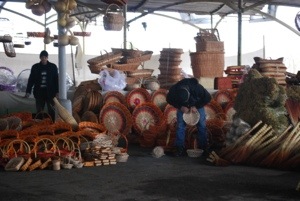
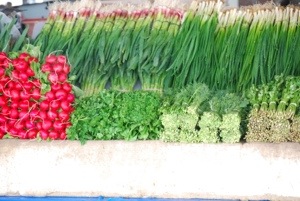
Lloyd and I bought a beautiful round of bread from among a vast array of beautiful bread. We wandered through a small area where folks sold used household goods ranging from waffle irons to faucets to hand tools. We found the vegetable section, the basket section, the straw broom section the candy section (delicious smells) the spice section (even more delicious smells) and the meat section (surprisingly unsmelly despite no apparent means of refrigeration). We thought we bought an unusually large kiwi but it turned out to be an unusually green radish. We were ‘salaamed’ and ‘good morninged.’ We saw no other Westerners. We avoided puddles seeping from buildings. We salivated over bowls of noodles and beautiful fresh fruit. We loved it.

After the bazaar we walked to Khost Imom complex. We took pictures but didn’t spend much time as we’re going there tomorrow on official tour. Then we took to the streets of the traditional old city. The sidewalks were broken or didn’t exist. Water wept onto the street from small drainage canals. The walkways were furiously swept of debris, despite their composition of mud and busted concrete. Here and there the bones of the mud-and-straw walls peeked through their whitewashed plaster covering. Children in bright clothing and seemingly anachronistic backpacks walked home from school. Mothers watched toddlers’ antics. Older folks sat in chairs in gated courtyards, the gates slightly ajar so they could observe the machinations of the neighborhood. Occasionally, a freshly renovated garage door or set of windows belied a wealthier resident. We got lost, but, in doing so, found our way to observe this society. We clearly didn’t belong but, perhaps not as oddly as one might think, we were glared at a lot less than we were yesterday. People looked at us with curiosity, but I didn’t sense animus.
20130312-062232.jpg

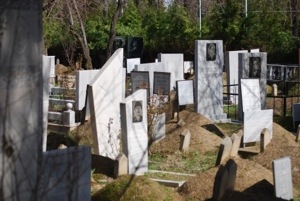
After winding our way through the neighborhoods, we found our way to Chagatai Cemetery. According to the guidebook, this is a neighborhood cemetery with a “crowded mix of Muslim and Soviet Style remembrance”. By this time the sun had come out in full force, strong and warm, and we were sweating through our jackets. We took advantage of the many, many corners to sit an contemplate to, well, sit and contemplate. We heard crows (as one might, in a cemetery) and saw only maintenance workers and a couple of people paying respects. The main part of the cemetery hosts regular citizens while one smaller section features memorials to “servants of the people”, each commemorated with forceful busts. Freakishly, Lloyd claimed he saw a black, wild dog. We haven’t seen but three dogs in this country. I didn’t see this one. It seems like an omen to me, but I’m not going to let it temper my vacation.
20130312-062246.jpg

We left the cemetery. I thought I might want some tea. We walked past a shop with a fantastic, indoors tropical courtyard. A few men sat at tables drinking tea from green and white ceramic tea pots. But, as with the circus the day before, we couldn’t figure out how to give anyone our money and order tea. Just outside the door, a small group of men gathered around a man slightly older than we are as he flew a kite. The white kite seemed to float serenely against the clear blue sky. The man eagerly encouraged me to hold the string (while he kept protective hold on the stick around which wound a good amount of brilliant white string). The string, exhibiting a deceptively gentle bow toward earth, strummed and vibrated in my hand and cut against my skin. I could tell, with the limited give the kite’s master gave me, that I in no way would be able to control that kite as it sought to ride the upper air currents and escape into the atmosphere. The group of men, all in black, all sporting dark looks and quiet demeanor, broke into smiles as I gawped and then laughed at the power of that paper kite and cotton string.

20130312-062303.jpg

It was a day for kites. The breeze was steady, the sun warm and the sky crystal clear an blue. We saw them sold along the street. We saw them floating on the horizon. We saw children and adults flying them. We saw fathers teaching their sons how to fly them. The number of kites tangled in the power lines were a testament to their popularity, and to the vagaries of the wind and the challenge of controlling kites in the city streets.

20130312-062321.jpg

The last highlight of our outing was a stop for lunch at a clean, simple restaurant. First, we passed the open doorways of the kitchen area with a concrete, mounded bread oven and open flames. Then we passed the windows of the dining room and noted the number of diners and the comfortable look of the dining area. Finally we came to the doorway through which was passing a satisfied diner who said “Welcome” and made such a gracious, welcoming gesture into the interior we felt like long-expected guests. The waiter asked if we spoke Russian but seemed to be able to communicate perfectly well in English. We were served green tea and ordered food based on pictures in the menu. We each got a noodles dish (after seeing those wonderful mounds of noodles earlier in the bazaar how could we not?) and got two distinctly different and decidedly delicious dishes. We walked away satisfied and happy.
20130312-062345.jpg

The walk back to the hotel allowed us to retrace some of yesterday’s route. We found the sidewalks and walkways to be much more lively and friendly than yesterday. Instead of glares, many people tried to talk to us. People asked us if we were tourists (really, how could they tell?) and tried their English on us. If we found someone staring curiously at us, one of us would say “sala’am alaykum” and, more often than not, the person would break into a smile and greet us in return. When we passed yet another open hole in the middle of the sidewalk with no protection, warning or barrier, Lloyd said “Here you can see what good all the law suits in America can do.”

20130312-062430.jpg

We spent the rest of the day trying to ease our weary bones. We both jog on the treadmill, yet today’s walk seemed quite strenuous. We thoroughly enjoyed our outing and loved all of our discoveries in Old Tashkent.

Erica’s lessons for travel

I recently read an article listing lessons every traveler must learn and, as I was sitting in JFK waiting for a flight to Istanbul and our ultimate destination of Tashkent, I was inspired to write my own version. I don’t want to present these as universal truths. Instead, these are Erica’s travel lessons.

Although many of the lessons in the article were useful, I, myself, have never had cause to use them. These particular lessons were tempered by the author’s experience. For example, one lesson was that you will get robbed – as in, you will get held up and mugged. While I always prepare for this eventuality (these preparations also work for the eventuality of losing your wallet) I have never been robbed. Not in any big cities of the US, not in Cairo, not in Jeddah, not in Kathmandu, not in Damascus not in Tashi’s Guest House on the Tibetan plane (although a monk in a saffron robe did come through the unlockable door to our room, I think his intentions were benevolent). Another lesson was to be prepared for other tourists. Again,I found less application for this lesson. I try to prepare for being jostled by those who don’t share an American sense of space, but I also travel during the off season and I don’t usually encounter waves of other tourists.

Here are the travel lessons I have learned.

Lesson 1: it pays to be a neurotic traveler. My husband and I arrive at airports ridiculously early. As I write this, I am sitting in JFK, five hours before our Turkish airlines flight to Istanbul on our way to Tashkent. Our original flight from RDU offered no margin for error, so we watched in trepidation an approaching winter storm (Saturn, for those who ascribe to winter storm naming). We managed to get on an earlier, though much-delayed flight and arrived at JFK with time to spare and much relaxed. How early? The checkin gate doesn’t open for three more hours.

Corollary to Lesson 1: be prepared to content yourself in any situation, with or without such luxuries as sleep, comfortable seats, clean restrooms, reading material or places to plug in your iPad. Learn to people watch. Or drink beer. Or people watch while drinking beer. That’s me you see on the concourse drinking a Stella and admiring the international, cosmopolitan crowds surging past my table.

Lesson 2: apply Blanche Dubois’ dictum to travel. Specifically, adopt a long, Southern drawl and say “I have always depended on the kindness of strangers” (I saw “Streetcar Named Desire” at Penn State Centre Stage Theater; now that I live in the South, I think the actress’ Southern drawl might have been a little over the top, but, forever in my head, every vowel in that phrase is pronounced aahhhh). Lloyd and I were consulting our Lonely Planet on a sidewalk in Beijing, finding our way back to the subway, when a man, on a scooter, stopped at a red light said, in perfect English, “where are you trying to go? Can I help you?” This is exactly the phrase a New Yorker spoke to me in 1987 when I was consulting a map trying to get to the World Trade Center (little understanding at the time the significance these two buildings would have on the country’s psyche). There have been multiple times in the Middle East when a third party offered to translate and negotiate a transaction for us.

Corollary to lesson 2: I don’t want to sound naive. I know there are people who want to overcharge or even steal from an unwary traveller. But I find I get a lot more pleasure from believing in the best of people and finding, 98% of the time, that I’m right. And if someone overcharges me, well, I figure they need the money more than I.

Lesson 3: Pack light and bring cold medicine. I’m still learning this one. This trip is the lightest I’ve ever packed and I think I’ve made a breakthrough. But I learned that nothing makes my travel more pleasant than having, at ready hand, those over the counter remedies that make annoying symptoms bearable.

Corollary to lesson 3: be prepared to smell badly, pay for laundry service, or both. In China, we paid pennies for laundry service at hotels. I could have packed a lot lighter. In Tibet, we had a couple of days in a town between tour groups when we booked back-to-back tour packages. I decided to have someone wash my underwear. I had lost about 30 pounds in the 6 previous months and my underwear was voluminous, white and cotton (gigantic granny-panties). I don’t know what I expected: the guest house where we stayed had no electricity and no running water; we had to take a flashlight to the squat toilets where “flushing” involved dipping water out of a bucket and washing the waste down a pipe onto the hillside below. We were eating thugpa (yak stew) at the town’s eatery when I looked across the street, at the stream running through the town’s main (one) street and saw a woman in traditional Tibetan dress scrubbing gigantic, white, balloon like panties in the stream. She would scrub, hold them up, inspect them, and lower them for additional scrubbing. I watched in horror as townspeople walked by alongside country folk in town for the weekend market. After the man carrying half a skinned goat passed by and I could see clearly what the woman was holding up I exclaimed, “Lloyd, are those my drawers?” After that, I’m ready for just about any laundry experience.

Lesson 4: Eat ANYTHING: I LOVE LOVE LOVE street food. The squid and the purple bao in Shanghai (although the bao was, technically, bought in a convenience store). The sweet, salty, peppery fruit slices shaken and served in a plastic baggie in Bangkok. The French fries by the outdoor pool tables in the dark, quiet, secondary streets of the Balad in Jeddah. The sugar cane drinks from the Balad. The sweet fondant and pistachio dessert molded into and extracted using a hammer from a wheelbarrow – the most basic food cart. The ‘choose your own pot of boiling stew from the line of pots of boiling stew’ in Bangkok. The breakfast pancakes with salty, salty soy sauce in Beijing. The gigantic discs of bread and freshly crushed fruit drinks in Xi’an. The banana pancakes in Phuket. Oh, and my first ever and most beloved street food: soft pretzels in Philadelphia.

Corollary to lesson 4: bring pepto AND Rennie. Because you never know what will work and you might need both. ‘Nuff said.

But travelers don’t HAVE to learn these lessons. Each person’s travel experiences -and, hence, their lessons – are different. These are just mine. These are all the lessons I have for now. A this trip unfolds, I may develop others.